Urdhva Dhanurasana
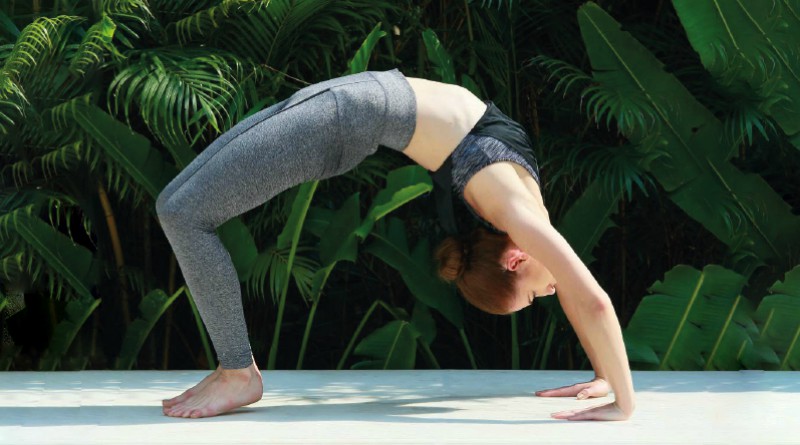
The name is derived from the Sanskrit words ‘urdhva’ or upward facing and ‘dhanur’ meaning bow and ‘asana’ meaning posture.
Instructions: Lie flat on your back on the floor with your arms placed beside you, palms facing downwards and legs hip width apart. Bend your knees and bring the soles of both feet as close to the buttocks as possible. Make sure that your feet are hip-width apart. Bring your hands behind each corresponding shoulder, palm facing downwards, fingers open and pointing towards the shoulder. Inhale and lift your body off the floor by pressing the soles of the feet and the palms firmly into the floor. The body will form a bow shape as you lift it towards the ceiling. Lift it as much as you can ensuring that your legs and knees stay in line with the hips and do not splay outwards to avoid putting pressure on the back. Let your head hang gently. Your neck should be long. Breathe calmly as you hold the pose for 30-60 seconds. Exhale and gently lower the body and go to starting position. Lie down calmly in shavasana between the postures. You can repeat the asana 2-3times.
Benefits:
- It stimulates the pituitary and thyroid glands.
- It helps to expand the chest and stimulates and expands the lungs and increases oxygen supply and hence is very good for asthmatic patients.
- It massages the internal organs and improves digestion and elimination.
- It stretches and tones the legs, abdomen, buttocks, spine, shoulder blades, glutes, hamstrings, wrists and arms.
- It is known to help in stress relief and treats depression.
- It stimulates the reproductive system and helps in curing infertility.
Caution:
- Avoid this asana if you are suffering from spinal or wrist injury or carpal tunnel syndrome.
- People with high blood pressure and headache and migraine problem should not perform this asana.